

Canada's Artisan Candle — handcrafted in Montréal, Canada since 2018
The Art of the Candle
Scented soy candles hand-poured with intention. Discover SOJA&CO.'s complete guide to choosing, using and loving the perfect candle for your home.

introduction
What is a candle, exactly?
A candle is one of the oldest and most enduring sources of artificial light — but today, it is so much more. For millennia, candles served a purely practical purpose: to push back the darkness. Today, the candle has evolved into a powerful tool for atmosphere, wellness and self-care.
At SOJA&CO., Canada's premium scented soy candle company, we believe every candle should be an intentional object — crafted with the finest ingredients, designed to scent your space beautifully and made to last. Whether you are new to candles or a devoted collector, this guide covers everything you need to know.

5000+
years of candle history

50 hrs
average burn time, SOJA&CO. soy candles

100%
natural soy wax
Why burn a candle?
The benefits of using a candle
Beyond their glow, scented candles offer meaningful benefits — for your mood, your space and your daily rituals.

The warm, flickering light of a candle is unlike any other light source. It softens a room instantly and creates a sensory experience that no lamp can replicate.

Fragrance has a direct neurological effect on mood and stress levels. Scented candles with quality fragrance oils — like lavender or cedarwood — can promote calm, focus or energy.

A well-chosen candle is a design object. Its form, color and container all contribute to the aesthetic of a space — making it an effortless decorating tool.

Lighting a candle can be an intentional act — a signal to your mind that it is time to unwind, meditate or simply be present in the moment.

Candles are universally loved gifts — appropriate for any occasion, from birthdays and housewarming to corporate events and the holiday season.

In power outages or for outdoor settings, candles remain an indispensable source of soft, reliable light. Keep a few unscented pillars on hand for practical use.
Types
Every type of candle, explained
From tall tapers to tiny tea lights, each candle format has its own character and ideal use. Here is how to tell them apart.

Freestanding
Pillar & taper candles
Pillar candles are solid, self-supporting cylinders that come in a range of heights and diameters — they need no container and are ideal as sculptural centerpieces. Taper candles are tall, slender and designed for candelabras or taper holders. Both formats suit formal dining tables, fireplaces and statement displays. Their burn time is typically long, making them excellent value.
Small-format
Votive & tea light candles
Votive candles are small cylinders (typically 5–7 cm tall) designed to be placed in a votive holder where they melt fully into the vessel. Tea lights are even smaller, housed in thin metal or clear plastic cups. Both are affordable, versatile and available scented or unscented. They work beautifully in clusters to create ambiance at events or along a dining table.


Home wellness favourite
Container & jar candles
The most popular candle format for home use: wax is poured directly into a glass jar, ceramic vessel or tin and allowed to cure. Container candles offer the longest burn times, the strongest scent throw and the safest format — since the container catches all melted wax. SOJA&CO.'s signature scented soy candles are all container candles, hand-poured in Montréal, Canada with premium fragrance oils and natural cotton wicks.
Artistic & seasonal
Novelty & decorative candles
Shaped candles — sculpted fruit, geometric forms, floral designs — are as much art objects as they are functional. Seasonal and holiday candles fall into this category too. Decorative candles are perfect for gifts and styled shelfscapes. They may or may not be intended for burning — their visual impact is their primary purpose.

Materials
Candle wax types compared
The wax you choose determines how a candle burns, how it scents a room and what environmental impact it has. Here is a clear comparison of the most common candle wax types.
SOJA&CO.'s choice
SOJA&CO. uses 100% soy wax for all candles — chosen for its clean burn, exceptional fragrance retention and renewable origin. Discover our complete guide to healthier, eco-friendly candles.
| Wax type | Source | Scent throw | Burn quality | Eco profile |
|---|---|---|---|---|
|
Soy wax (SOJA&CO.) |
Soybean plant |
Excellent — especially cold throw |
Slow, clean, low soot |
Renewable, biodegradable, vegan |
|
Beeswax |
Honeybee hives |
Subtle natural honey scent |
Very slow, very clean, bright flame |
Natural, not vegan, limited supply |
|
Paraffin |
Petroleum by-product |
Very strong hot throw |
Fast burn, produces soot & VOCs |
Non-renewable, not biodegradable |
|
Palm wax |
Palm oil |
Good |
Hard, crystalline finish, clean burn |
Renewable, but deforestation concerns |
|
Gel wax |
Mineral oil + polymer |
Good (transparent) |
Very long burn, requires care |
Petroleum-derived, not biodegradable |
Scent
Fragrance & essential oils for candles
Scent is the soul of a candle. Understanding fragrance families helps you choose candles that genuinely match your mood, space and season.

Lavender, rose, peony, jasmine. Calming and romantic — perfect for bedrooms and bathrooms.
shop our floral candles

Cedar, sandalwood, fir forest. Grounding and warm — ideal for living rooms in fall and winter.
shop our woody candles

Melon, citrus, green apple. Light and energizing — lovely for spring and summer.
shop our fresh & fruity candles

Cinnamon, cardamom, amber. Cozy and festive — evocative of the holiday season.
Fragrance oils vs. essential oils
Essential oils are pure plant extracts — 100% natural, with true aromatherapy potential. They tend to have a softer scent throw in candles and may not hold as consistently through the full burn.
Premium fragrance oils are carefully formulated blends — often combining natural isolates and safe synthetic compounds — that deliver a more complex, stable and long-lasting scent throw. SOJA&CO. uses curated fragrance oils selected for their safety, complexity and compatibility with soy wax, so your candle scents your space from the first burn to the last.
To learn more about our fragrances and their ingredients, visit this page.
Buying guide
How to choose the right candle
With so many options available, here are the six most important factors to guide your decision.

01.
Wax type
Prioritize soy wax or beeswax for a cleaner burn. Avoid pure paraffin if indoor air quality is a concern — it releases soot and volatile compounds when burned.
02.
Wick material
Choose candles with natural cotton wicks, free of lead and zinc. A good wick burns evenly, minimizes mushrooming and keeps the melt pool consistent.


03.
Burn time
Soy wax candles burn 25–50% longer than equivalent paraffin candles. Check the manufacturer's estimated burn time — a 200 g soy candle should give you 35–50 hours.
04.
Scent strength
Consider where the candle will be used. A small bedroom needs a lighter scent load; a large open-plan living space benefits from a higher fragrance concentration.

05.
Container quality
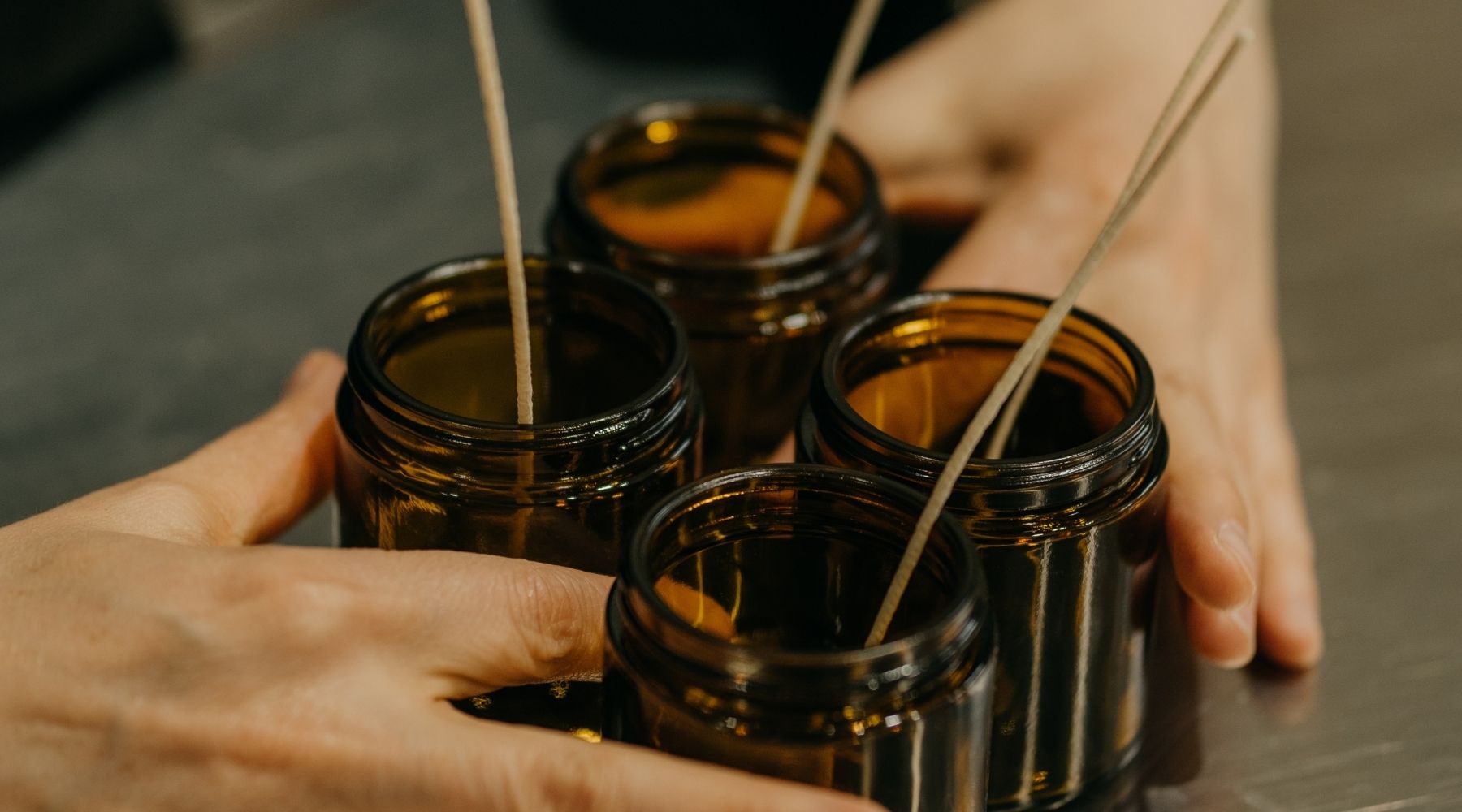
A well-made glass jar distributes heat evenly, prevents overheating and — once the candle is done — gives you a beautiful reusable vessel. Look for thick, heat-safe glass.
06.
Intended use
Relaxation calls for lavender or floral scents. Entertaining calls for light citrus or fresh notes. Gifting calls for a beautiful, classic fragrance that suits any taste.

Candle care & safety — done right
A long wick produces an oversized flame, generates soot and causes uneven melting. Use a wick trimmer or simply pinch off the charred tip once the candle has cooled completely.
To learn more about how to care for our products, visit this page.
On your candle's first lighting, burn it until the entire wax surface has liquefied edge to edge. This prevents tunneling — a hollow channel that forms when soy wax is not allowed to melt evenly and permanently shortens burn life.
Extended burns overheat the wick and the container, degrading both scent quality and safety. Let the candle cool completely before relighting.
Always extinguish your candle before leaving the room or going to sleep. Keep candles on a stable, heat-resistant surface, away from drafts, curtains and flammable materials — and always out of reach of children and pets.
Burning a candle to the very bottom overheats the glass and can cause cracking or thermal shock. Stop at the 1 cm mark, then clean the jar with hot water and soap to reuse it.
Soy wax is sensitive to heat and UV light. Direct sunlight can cause discoloration and fragrance fading. Store your candles in a cool drawer or cabinet to preserve scent and texture between uses.